

Welcome to The Content Report, a newsletter by Vince Mancini. I’ve been writing about movies, culture, and food since the late aughts. Now I’m delivering it straight to you, with none of the autoplay videos, takeover ads, or chumboxes of the ad-ruined internet. Support my work and help me bring back the cool internet by subscribing, sharing, commenting, and keeping it real.
—
The toughest part of writing this review was the belated realization that I had to change the title of the feature. It used to be called “the Toddler Dad Movie Revue,” which has a much better mouthfeel, but then Google informed me that my son is no longer a toddler.
That stage, apparently, ends at age three. Makes sense, I suppose. He no longer really “toddles” around. Now he runs and jumps and even swims, all while keeping his head perfectly still like Fred Flintstone, which never doesn’t crack me up. (I assume he learned this from going through his first few phases with a 97th percentile-sized skull).
The other day, fresh off another round of swim lessons, he showed me how he could swim all the way to me from the short side of the pool. He climbed up on to me, smiled, and started rubbing my shoulder with his hand. My heart was all a-swell, since mom is usually for sweetness and comfort, while dad generally functions as combo punching bag/human jungle gym. Just as I was thinking about what a pleasant reversal this all was, he said, in his sweetest child voice, “It’s spit.”
Ah, yes. That would explain the shoulder rubbing.
Now, does this realization, that he’ll never be a toddler again, and that by the time I could truly appreciate it, it was already gone, and that the same thing will inevitably happen with this stage, and the next, and the next, hit me like a dagger to the guts every time I stop and take the time to think about it? Of course, and that’s just the kind of maudlin sentimentality on which the Toy Story franchise was built. It worked on me long before I even had a child of my own, as do most ain’t the passage of time a bitch? narratives (see also: most Peter Pan-related stories).
The way Toy Story assigns sentience to toys (a gift to the toy manufacturers, the bane of declutterers) is a little consumerist and gross on the face of it, sure, but it’s an effectively straightforward metaphor for the parenting process: the better you do your job, the more irrelevant you become. We’ve all got a bit of Woody in us, don’t we? (Not as much as your mom).
Preschooler Review
I brought my son and his not-my-literal-nephew-but-still-calls-me-uncle best pal who just turned five, and they were suitably stoked even before I loaded them up with snacks and icees (one of the first lessons of parenting: bribery works). My not-literal-nephew was singing the theme song before we even hit the lobby door. Never underestimate the power of good theme music (see also: the difference between Moana and Moana 2). Toy Story has never been my favorite of the Pixar franchise(s?), but it’s arguably the one that has most broken through to both kids and adults. Being the longest franchise probably has a lot to do with that, but Randy Newman music and Tom Hanks voicing a cowboy doll are a match made in heaven.
During the opening credits, the preschoolers actually argued with each other about who the little Pixar lamp animation was looking at during the credits sequence. He was looking at me! No, he was looking at me!
It’s a cute lamp. No one denies this.
As for the actual film, I wouldn’t say that they were over the moon with glee, but they remained in their seats the entire time and never hassled me for more candy or fidgeted too badly or asked to do something else (generally a 50/50 proposition at this age). That the theme of this installment was big tech was probably lost on kids this age, along with the couple of scenes in which information was conveyed by onscreen text messages.
They understood vibes though. By and large, this Toy Story functioned, like most Toy Story movies do, as a sort of extended chase sequence. And it’s not hard for little kids to understand chase sequences or the mechanics of being left out.
Did they like it? Certainly. Did they love it? I’m not convinced. They were interested. It was fast-paced enough, but also didn’t have any mind-blowing visions of other worlds or brain-expanding action. It did, however, have characters they recognized and compelling action. Very much a case of “good enough.”
They didn’t exit the auditorium buzzing about what they had just seen — remember this? remember that? remember when that one thing went da-da-da? — but they were happy. It seems like the kind of movie where they left remembering a good time at the movies rather than the mind-blowing movie they just saw, which is maybe not the best compliment for the movie, but a pretty good outcome for dad.
Adult Review
As noted, the villain of this fifth installment of Toy Story is “tech” — manifested in the form of a frog-themed iPad-like device called the “Lilypad.”
Our main child, Bonnie, who took over Andy’s toys in Toy Story 3 and 4 (I saw these movies but still had to Google this), is trying to make friends across the yard with some neighbor kids in an early scene. Shy Bonnie musters the courage to wave at the neighbor kids (boy and girl fraternal twins) with her toy, kid-like, only for them look at each other in confusion and run back inside their house.
Bonnie’s parents, who witnessed the interaction, share confused glances, trying to make sense of what just happened. Looking around the neighborhood through a Rear Window-style wide panning shot, they come to discover that none of the kids Bonnie’s age are playing with each other anymore. They’re all glued to their dang devices! Eyes transfixed and faces aglow with the blue light of their screens.
Too real? Maybe a little.
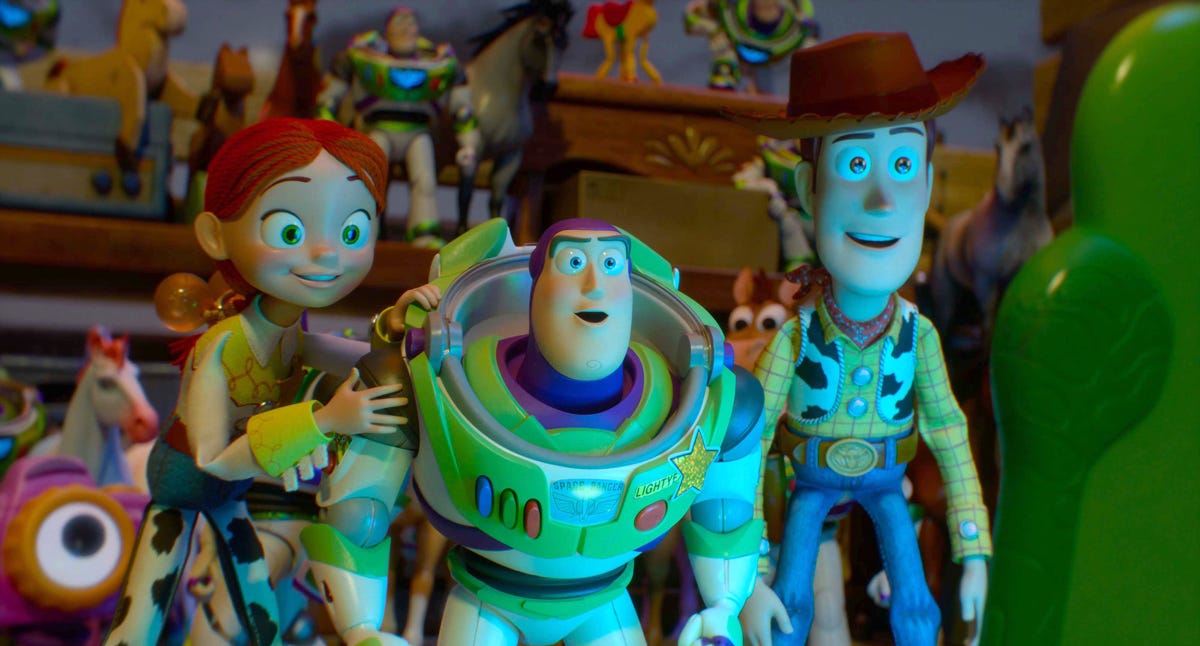
Bonnie’s toys, led by Cowgirl Jessie (Joan Cusack) and Buzz Lightyear (Woody and his toy wife, Bo Peep, live with another boy now), come to the same frightening realization as Bonnie’s parents: that they toys might be obsolete, along with the act of “playing” itself, and maybe “friendship” too. Or at least, playing and friendship as they’ve come to understand them.
Bonnie’s reeling parents, not knowing what to do, buy Bonnie a Lilypad of her own, who the rest of the toys all reflexively fear and dislike, with the anthropomorphized “Lily” (voiced by Greta Lee), becoming the sort of know-it-all frenemy of the group. Jessie goes on a tirade, blaming Lily and the dreaded “devices” for making kids grow up too fast and alienating them from each other. Lily protests, using her software to make Bonnie two new “friends” on the “pond” app. “She did it in 15 seconds!” gasps Trixie the Triceratops. “I counted.”
Still on the fence about whether tech like Lily can be friend or foe, Cowboy Jessie (with help from Woody, with whom she consults over a walkie-talkie), connives a sleepover plan with Bonnie’s online friends that, in the end, only seems to further Bonnie’s sense of alienation from her peers and shame over her own childishness. She wants to play but all they want to is fiddle with their tablets, and they make her feel bad about it. Man, this future sucks! Ditch these cunts before it’s too late, Bonnie!
Toy Story 5, co-written and co-directed by McKenna Harris and Andrew Stanton (the latter a co-writer of the previous four) gets points for boldness, though one of its greatest failings is that it presents such an intractable social problem in the first act that all its folksy solutions end up feeling timid, or like deflections. It’s hard to blame them for not “solving” something so big, but at the same time, they’re the ones who asked the question.
It’s basically Toy Story canon that one or a group of toys must become separated from the rest of the group (as a result of fate or a child’s capricious whims, later to be regretted). In Toy Story 5, that task falls to Cowgirl Jessie, who, through a series of events too complicated to recount here, ends up at the house of her original owner in the 1960s (ish), where now lives Blaze, a potential friend for Bonnie. In order to get the gang back together and save Bonnie from life as a lonely outcast, Buzz and Woody have to team back up with their respective groups of toys to save Cowgirl Jessie and get Bonnie to ditch her fake friends so she can rock out with Blaze, the only other kid in town with a real imagination.
Which is to say, tech isn’t entirely the big bad Jessie assumes it to be at the outset. The movie ends up being just as confused about what to say or do about it as any of the rest of us. Instead the real villain is something like peer pressure, or haters, and the message, delivered by Jessie late in the film, is something like “It’s not our job to tell you when or how to grow up, the important thing is being there when it matters.”
Sure? I suppose we can’t really expect a Toy Story movie to tell us what to do about predatory tech companies and surveillance capitalism, but there are times when the “can’t we all just get along”-style narrative feels as anachronistic as cowboy toys.
