'Caught Stealing' is the Best Y2K Indie Crime Movie Since the Y2K Era
Darren Aronofsky's gourmet 'Go' joins 'Weapons' and 'Sinners' in bringing back movie magic.

Welcome to The #Content Report, a newsletter by Vince Mancini. I’ve been writing about movies, culture, and food since the late aughts. Now I’m delivering it straight to you, with none of the autoplay videos, takeover ads, or chumboxes of the ad-ruined internet. Support my work and help me bring back the cool internet by subscribing, sharing, commenting, and keeping it real.
—

It’s probably hard for younger generations to imagine, but once upon a time, indie movies were big business. Every vaguely artistic teenager dreamed of being a filmmaker, and every aspiring filmmaker imagined one day directing their debut hit feature, which was generally conceived as some screwball comic caper vaguely reminiscent of Pulp Fiction. Aspiring Hollywood movers and shakers in turned lined the proverbial block looking to pluck the next Tarantino or Kevin Smith from service sector obscurity.
Overnight (2003) is a perfect slice of the times. Harvey Weinstein identifies bartender Troy Duffy as the new Tarantino based on a dopey spec script called Boondock Saints, and Duffy is briefly hailed as the next big thing before drinking it all away. Movies in which verbose men drove cool cars and held pistols while getting into underworld hijinks naturally got pretty stale some time in the years between the towers falling and the subprime mortgage crisis.
Probably no one needed to see another low-rent version of Go in 2006 (Doug Liman’s criminally underrated mashup of Pulp Fiction and Swingers from 1999), but Darren Aronofsky’s peculiar discovery is that in 2025, the perfect 1999 crime caper film feels unexpectedly timely. Especially when you factor in Caught Stealing’s new wrinkle: that rather than an ambitious-but-green newcomer behind the camera, we get middle-aged former wunderkind Aronofsky, directing a kooky crime caper as a throwback lark midway through a mostly acclaimed career. While everyone else was filming quippy action and gratuitous pistol play, Aronofsky was off making a black-and-white psychological thriller called Pi (1998). Caught Stealing offers the opportunity to relive the cultural moment, and maybe thanks to hindsight and nostalgia, it’s easily one of Aronofsky’s best films.
Charlie Huston, at one time sort of the Tarantino of novelists, adapts his own 2004 crime caper story for Aronofsky, who, it turns out, can direct the absolute piss out of a character-based screwball actioner. Caught Stealing works shockingly well, like a gourmet version of Go or Lock Stock and Two Smoking Barrels, arguably better than the original Go or Lock Stock and Two Smoking Barrels. Caught Stealing is more earnest, more patient, less self-consciously campy, and it’s no less entertaining or funny for it. In fact, between Sinners, Weapons, and now Caught Stealing, it’s starting to feel suspiciously like thinkpieces are out and pageturners are in. What if talented auteurs committed to genre and just let it rip? Is movie magic back?! This reviewer is ready to say: MAYBE.
From the title on down—immediately evoking the barking dogs from Jane’s Addiction perfect, and only good single1—everything about Caught Stealing marks it as a slice of the pre-9/11 crime film heyday, even if you don’t realize quite what it’s doing for the first few scenes. We open on Austin Butler as Hank Thompson, wearing his San Francisco Giants hat while working the bar at some punk rock dive. He yells at some fratty early 20-somethings in polo shirts to knock it off with the dancing or find another establishment, eventually offering free shots in trade. For a second I thought the bar might be Zeitgeist, a graffiti-and-stickers-covered beer joint famous for curmudgeonly bartenders in San Francisco’s upper Mission District, but it turns out we’re in New York’s East Village during the dying days of NYC grit. Hank, with his blond tendrils and Giants hat, just happens to be a Norcal transplant whose fresh face and obsessive baseball fandom identify him as an outsider.

Hank has a New York girlfriend, or maybe just a fuck-buddy at this stage, Yvonne, played by Zoe Kravitz. She finds Hank at the bar and they walk together to Hank’s crummy apartment after his shift. On their way to his door, they pass Hank’s mohawked, Cockney neighbor, Russ, in the hall, played by a weirdly perfect Matt Smith, who looks like a meticulous recreation of the cover model for Rancid’s “And Out Come The Wolves” (1995)2 come to life. Russ’s dad has had a stroke, he says, and so he needs Hank to watch his cat for him for a few days while he goes to London.
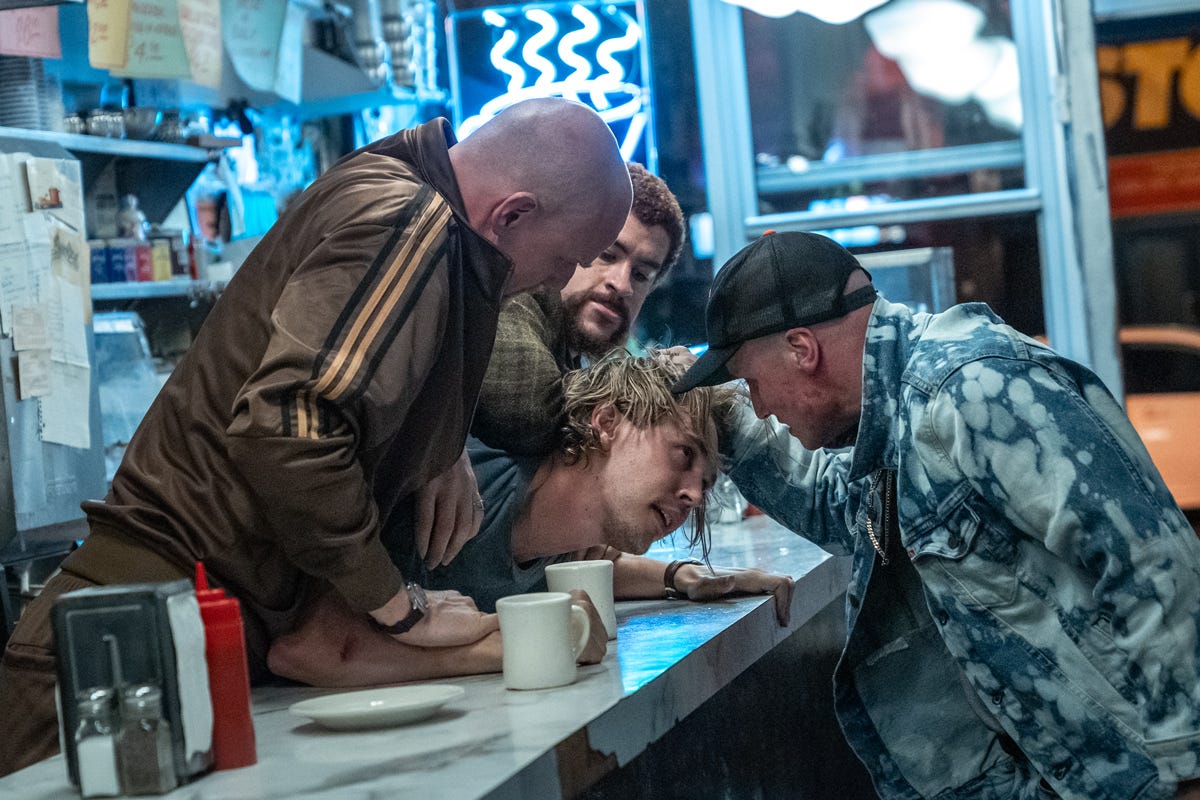
Ever since Inside Llewyn Davis, it’s become a deeply held position of mine that every script could use a magical cat. Here, Russ’s cat forms a sort of ethereal connection with the film’s macguffin (it’s a great cat). Some Russian thugs come looking for Russ the next day but only find Hank, delivering a beating so brutal that Hank loses a kidney. Now, not only does unrepentant booze hound Hank have to start laying off the alcohol, it seems that he’s caught up in a dangerous web of drugs, organized crime, and murder. And all because he half-heartedly accepted a cat-sitting assignment in the middle of trying to get laid.
I’m still not entirely sure whether Austin Butler is a great actor or a mediocre one, but he certainly has that Brad Pitt quality, of being so easy to look at that on some level it doesn’t really matter (an actor is, at its root, a person you enjoy watching do stuff). Hank is probably Butler’s best work so far, simply on account of it seems like he’s not working too hard. Hank, as we learn through a recurring nightmare in which his subconscious forces him to relive his worst moment, is a former baseball prodigy from Patterson, CA (love a Central Valley shoutout). He’s about to realize a glorious future when it all comes crashing down, in a hail of shattered glass and crumpled metal during a drunk driving accident that blows out Hank’s knee, destroys his chance at superstardom, and leaves him forever haunted with a guilty conscience.